
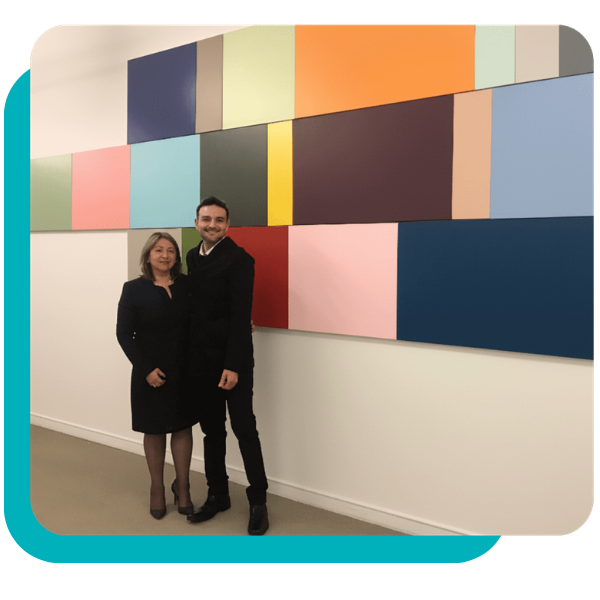
10 years, 10 questions. Inside the hearts of ArteLatAm’s founders.
A candid conversation with Sylvia Mata and Carlos Torres Machado on a decade of breaking barriers, empowering artists, and transforming communities from New York to the world.
Q1: Looking back to 2016, when you were first organizing local exhibitions and opening doors for Latin American creators in New York, what was the exact moment or spark that made you realize this project needed to scale into the certified, bilingual organization it is today?
-
Sylvia: “The true spark ignited when we realized that our artists’ talent was left floating in an institutional vacuum. At first, seeing the creators’ excitement when exhibiting in New York was wonderful, but reality hit us face-on: to open doors in the spaces that actually make the decisions in this city, we needed to speak the language of the system. The exact moment was understanding that we couldn’t just remain gallery managers; if we wanted equity and a sustainable impact for our community, we had to formalize, become bilingual, and seek government certifications to secure a seat at the tables where major cultural projects are defined.”
-
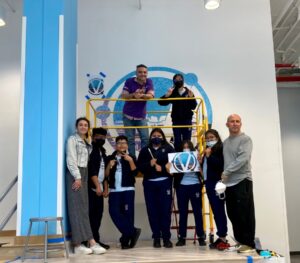 Carlos: “As an artist, I lived the entry barriers to the Anglo-Saxon market firsthand. Organizing exhibitions was the first step, but it quickly became clear that visibility without structure is fleeting. The spark was strategic: we realized that for Latin American art to be respected and funded on a large scale in the cultural capital of the world, ArteLatAm had to operate with the rigor of a corporation. Moving away from being a local initiative to transform into a certified entity gave us the legal and professional muscle to compete and demand the place our artists deserve.”
Q2: In one word, what was the biggest challenge of those first two years?
-
Sylvia: “Credibility.”
-
Carlos: “Access.”
Q3: What is the most nostalgic memory you have from your very first official exhibition?
-
Sylvia: “The grateful hug from an artist who told us, ‘I thought I would never see my work hanging in New York.’ In that moment, I understood that this was no longer just a project; it was a mission.”
-
Carlos: “The smell of fresh paint mixed with the opening night jitters. We were a tiny team making magic out of pure willpower.”
Present impact
Q4: Today, ArteLatAm is a powerhouse with M/WBE certifications, proven public sector experience, and a robust collective of architects, designers, and curators. Out of all these pillars, how has your hands-on work in public schools with the NYC DOE shaped your understanding of diversity, equity, inclusion, and belonging (DEIB)?
-
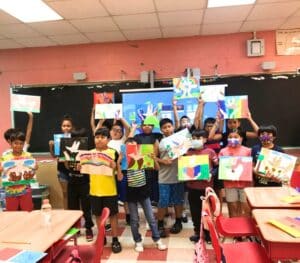 Sylvia: “Working in the classrooms of the NYC DOE has been the most transformative experience of these ten years; that is where diversity and inclusion stop being corporate buzzwords and become human faces. Seeing children from diverse backgrounds connect with their roots through art, and noticing how our bilingual nature fosters a deep sense of belonging for them, is priceless. It taught us that cultural equity doesn’t start in museums; it begins in childhood. The classroom is the very first public space where a child decides whether their identity is a source of pride or a barrier.”
 -
Carlos: “Our work in public schools completely redefined the purpose of our interdisciplinary collective. When you bring architects, designers, and visual artists together to design pedagogical and creative environments for children, you understand that art is an active tool for social transformation. It proved to us that inclusion is about decentralizing art: taking the technical and conceptual excellence that we handle at art fairs directly to communities that have historically been marginalized from these processes. Changing a child’s environment through color and creativity is sowing pure belonging.”
Q5: How does having the M/WBE certification change the game for a Latin American art organization in New York and New Jersey?
-
Sylvia: “It strips away the ‘charity project’ label and places us firmly on the map as official government vendors. It validates that Latino culture is professional, competitive, and highly necessary.”
-
Carlos: “It gives us a legitimate seat at the table for public bidding. We no longer ask for space as a favor; we compete for institutional contracts with our heads held high.”
Q6: Why was it non-negotiable for ArteLatAm to be a 100% bilingual organization from day one?
-
Sylvia: “Because language should never be a barrier to talent. Being bilingual allows us to protect the essence of our artists while simultaneously connecting them with opportunities in the English-speaking world.”
-
Carlos: “It is a declaration of identity. Operating in both English and Spanish proves that the Latino community does not have to assimilate by losing its roots; we navigate both worlds with total fluency.”
Q7: How would you describe the superpower of the ArteLatAm Collective?
-
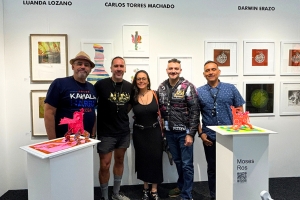 Sylvia: “Collective resilience. When one artist in the group moves forward, they pull up and elevate everyone else.”
 -
Carlos: “Interdisciplinarity. Watching an architect, a designer, and a painter debate a public mural is witnessing Latino genius in its highest expression.”
Future vision
Q8: You often say that after a decade of challenges and lessons, you are “only getting started.” When ArteLatAm celebrates its next major milestone, what does that ultimate horizon look like for the collective and the Latin American cultural identity in public spaces?
-
Sylvia: “When I look to the future, my ideal horizon is seeing ArteLatAm consolidated as the undisputed institutional benchmark for Latino culture in the United States. I imagine a legacy where future generations of artists won’t have to face the hardships we did because a bulletproof platform already has their backs. My dream is for our community to know that their stories, their memory, and their identity are permanently protected and celebrated in the most important institutions of this country.”
-
Carlos: “Saying we are ‘only getting started’ means we have already built the foundations and now it’s time to build on a grand scale. At our next major milestone, I see ArteLatAm leading monumental public art projects and architectural landmarks that redefine the urban landscape of the world’s major cities. I envision the ArteLatAm Collective not just participating in the cultural conversation, but setting the standard for how public art can heal, integrate, and beautify communities. We want Latin American identity to be synonymous with vanguard, solidity, and global leadership.”
Q9: If you could give one piece of advice to a Latin American artist arriving in New York today, what would it be?
-
Sylvia: “Never dilute your identity or your roots to fit in; that is your greatest competitive advantage.”
-
Carlos: “Understand that talent is only half the job; the other half is discipline, strategy, and building community.”
Q10: Complete the sentence: “ArteLatAm is…”
-
Sylvia: “…home, community, and unyielding passion.”
-
Carlos: “…the future of Latin American cultural leadership.”
Post Tags :
- 10thAnniversary
- Anniversary
- ArtCollective
- ArtEducation
- Artelatam
- ArteLatAm10
- ArteLatinoamericano
- ArtInPublicSpaces
- BilingualOrganization
- CommunityDriven
- ConnectingRoots
- CorporateArt
- CulturalIdentity
- CulturalLeadership
- Dayanara Reyes Pujols
- DEIB
- DiversityAndInclusion
- InterdisciplinaryTeam
- LatinAmericanArt
- MWBE
- MWBECertified
- NewJersey
- NewYorkCity
- NYCDOE
- PublicArt
- PublicSchools
- PublicSectorExperience
- SocialTransformation
- StrategicAlliances
- TriStateArea
- UrbanArt