
Mental health and the therapeutic power of art in NYC
Mental health and the therapeutic power of art in NYC
Living in New York City involves a sensory and stress load that few places in the world can match. The frenetic pace of Manhattan, the competitive pressure of its creative and financial industries, and the isolation that life in a metropolis of over eight million people often produces, create an environment where mental health is frequently compromised in silence.
In this post-pandemic context, art has ceased to be a simple aesthetic ornament or a collector’s item to become an indispensable tool for emotional survival. According to a recent report from the New York City Department of Health, anxiety and chronic stress affect one in five New Yorkers; it is precisely in this void where artistic creation intervenes as a non-invasive medicine with high social impact.
Science overwhelmingly supports this connection through neuroaesthetics. Research published by Drexel University in Philadelphia demonstrates that engaging in creative activities—regardless of an individual’s talent or experience level—for just 45 minutes drastically reduces cortisol levels in the body, the hormone responsible for stress.
At Artelatam, we observe daily how art allows our community to process the impact of migration, nostalgia, and culture shock. By painting, drawing, or sculpting, the brain enters a state of “flow” that allows one to disconnect from the external noise of the Big Apple. As the World Health Organization (WHO) points out in its 2019 report, participation in cultural activities not only assists in managing mental illness but also strengthens social resilience—a critical factor for the cohesion of New York’s urban fabric.
 Regarding this transformative capacity, Carlos Torres Machado, artist, co-founder, and Executive Director of Artelatam, provides a perspective based on years of direct intervention across New York’s boroughs. Torres Machado maintains that art does not only heal the individual in the intimacy of their studio; it possesses a regenerative power when moved into public spaces and educational systems:
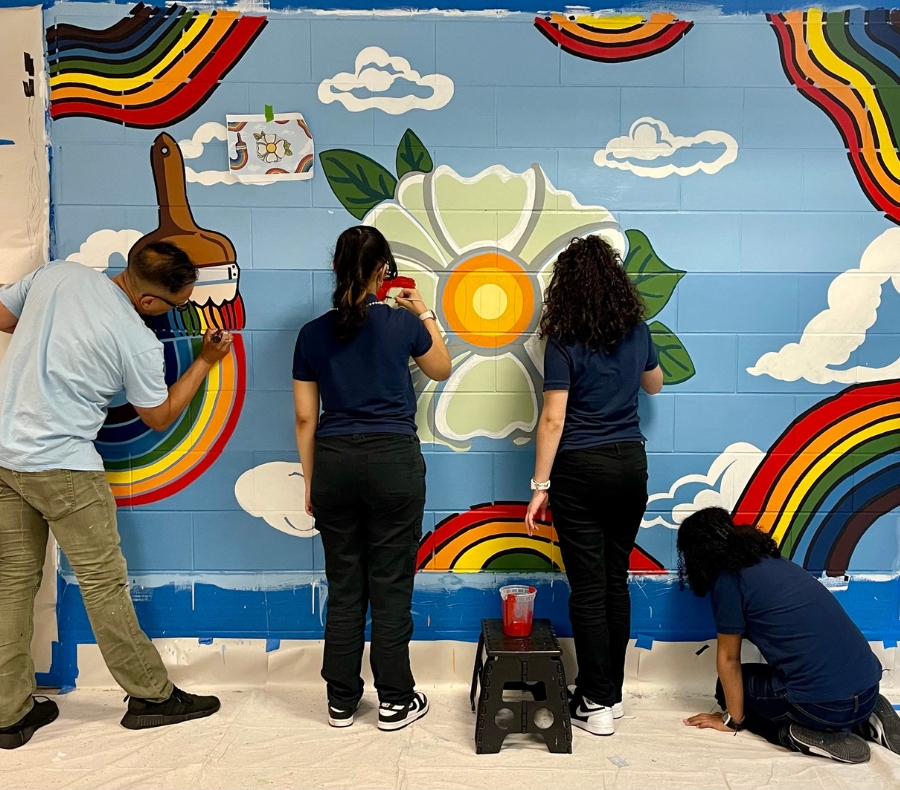
“Public art in New York acts as a thermometer for community health. When we intervene on a wall in the Bronx or Queens, we aren’t just painting; we are altering the chemistry of the environment. A degraded space generates anxiety; a space intervened with art generates security and a sense of belonging. I have seen how communities that felt invisible recover their voice and their calm through a mural. It is a collective therapy that reduces the hostility of the asphalt.”
This vision extends to the educational programs Artelatam promotes in the city. For Torres Machado, the changes art brings to school curricula are structural and preventive. Art in schools should not be seen as a curricular filler; rather, it should be viewed as a masterclass in emotional intelligence.
 “In our schools, the art program is a space for emotional regulation. A child who learns to channel their frustration through clay or color is an adult less likely to succumb to the mental collapse imposed by this city. We are giving them tools so that their mind is not a victim of the environment, but a creator of realities,” states the Executive Director.
But the benefit goes beyond stress reduction. Art offers an escape route and, at the same time, an anchor of identity. For the Latino artist in New York, the work becomes a territory where they can reconcile their two worlds. By creating, the individual regains agency over their own narrative, transforming the city’s visual chaos into an original symbolic order.
This transition toward the digital and immersive also opens new doors. According to reports from the Hispanic IT Executive Council (HITEC), digitalization in art allows vulnerable communities to find new forms of livelihood and visibility, which alleviates economic pressure—another determining factor in the mental health of New Yorkers.
At Artelatam, under the guidance of leaders who understand art as a basic necessity, we promote these spaces of creation and educational programs not as a mere hobby, but as a form of rigorous preventive health. We firmly believe that a city that draws is a city that heals. Access to artistic materials, technical training programs, and exhibition spaces must be seen as a citizen’s right and an investment in public health.
As Torres Machado’s experience highlights, emotional well-being is the engine that keeps New York running. At the end of the day, art does not just decorate our city’s walls; it sustains the emotional structure of those of us who inhabit it, offering a sanctuary of peace and a tool for empowerment in the city that never sleeps. By investing in public art and creative education, New York is investing in its own wisdom and its capacity to imagine a more humane future.
Post Tags :
- Art as Medicine
- art education
- Art for Change
- Art Therapy NYC
- Artelatam
- Artistic Flow
- Bronx Art
- Carlos Torres Machado
- Community Healing
- Creative Education.
- Creative Survival
- Cultural Cohesion
- Digital Art Innovation
- Emotional Intelligence
- emotional well-being
- HITEC
- Identity and Art
- Latino Artists
- Latino Diaspora
- mental health
- Mental Health Awareness
- Neuroaesthetics
- New York Artists
- New York City Culture
- Preventative Health
- public art
- Queens Murals
- Social Resilience
- Stress Relief
- Urban Art NYC