
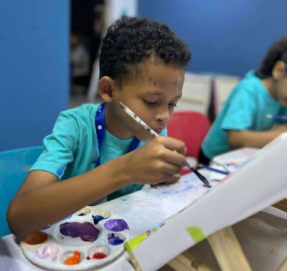
Strategic art and early inspiration
In the professional world of strategic communications, we often say that “content is king,” but relevance is the crown. As a Communications Manager, I spend my days analyzing audiences, crafting narratives, and ensuring that messages resonate with purpose. However, I recently faced the most important “audience management” challenge of my life: motivating my son, Mathías, during his literacy and language acquisition phase.
Living in a fast-paced city like New York, where educational standards are high and distractions are endless, finding a way to make learning to read and write an exciting journey rather than a chore is essential. Mathías is currently in that magical yet challenging stage of decoding symbols into sounds and words. As a communications professional, I knew that for the message (the education) to be absorbed, it had to be aligned with the receiver’s deepest passions. Therefore, instead of relying solely on conventional textbooks, I decided to design a personalized communication strategy based on his three great interests: Art, Soccer, and the Guitar.
Evolutionary storytelling
My strategy has been simple yet powerful: turning reading into a bridge toward his heroes. To keep him motivated, we integrated into his daily routine the stories of people who have reached excellence in the fields he loves. This is my way of connecting him with art from an early age and driving him to achieve his goals.
When we sit down to read the biographies of great painters, Mathías isn’t just identifying phonemes and letters; he is discovering that patience and vision are necessary to create something beautiful. Since he takes art classes, reading about the masters provides a historical and emotional context for his own creativity. He begins to understand that the strokes he makes on his canvas are part of a long human tradition of expression.
Similarly, we explore the lives of legendary soccer players. Soccer teaches him about teamwork, physical discipline, and perseverance. By reading about the struggles and triumphs of his favorite athletes, he learns that behind every goal, there is a story written with effort. This motivates him to write his own goals—literally and metaphorically.
Finally, we delve into the world of guitarists. Music has its own syntax and rhythm. By exploring the lives of great musicians, Mathías connects the rhythm of words on a page with the melody of the strings he hears. It transforms the literacy process into a harmonious experience, showing him that every instrument, including the pen, requires practice to find its unique voice.
Empowering communication
This approach is more than just an educational tactic; it is a strategic alignment of values. As noted by Nancy Rodríguez, Operations Manager at Artelatam, providing stability and purpose is key to any creative process. By applying this to my son’s education, I am ensuring that his “creative process” of learning is backed by the stability of his own interests.
As communication professionals, we often focus on large-scale campaigns and global audiences. However, the most critical communication happens at home. By aligning Mathías’s interests with his academic development, I am not just teaching him how to read; I am communicating to him that his passions are valid and that knowledge is the primary tool to reach any dream.
In New York, a city built on the stories of immigrants and dreamers, teaching a child to master their own narrative is the greatest gift a parent can give. I want Mathías to understand that whether he is standing before a canvas, on a soccer field, or holding a guitar, his ability to read and write his own story is what will make him truly free and successful in the future.
Strategic vision
At Artelatam, we believe that art is an anchor for life. This philosophy extends beyond professional artists to the children who will become the thinkers of tomorrow. When we use art as a motivational tool for literacy, we are fostering a generation that doesn’t just consume information but interprets it creatively.
As a mother and a manager, I see no boundary between the passion for art and the discipline of education. They are two sides of the same coin. By fueling my son’s curiosity with the lives of those who changed the world through their talents, I am helping him build a bridge toward his own greatness. In the end, education is the most sophisticated form of communication, and art is the most profound way to express what we have learned.
Post Tags :
- Affective Communication
- Art and Sports
- Art for Kids
- Artelatam
- Biographies for Children
- Child Empowerment
- Child Resilience
- Childhood Development
- Childhood Literacy
- Communications Manager
- Creative Education NYC
- Creative Leadership
- Cultural Management
- Dayanara Reyes Pujols
- Education and Communication
- Educational Storytelling
- Guitar for Kids
- Inspiration for Kids
- Mathías Castillo Reyes
- Meaningful Learning
- Multicultural Education
- Music in Education
- NYC Education
- Passion for Art
- Positive Parenting
- Reading and Writing
- Soccer and Learning
- Stories of Artists
- Strategic Motivation
- Teaching Methods